


Skip to content
    Neuroplastiq

    Accelerate creating your common data model and speed up your AI transformation.

    Your systems already contain the data your business depends on. Understanding what data you have, what it means and how it fits together takes a lot of time.

    Neuroplastiq analyses your source systems and proposes shared entities, attributes, relationships and definitions for your team to review. Bring fragmented data into a common model, resolve differences and prepare it for integration, analytics and AI.

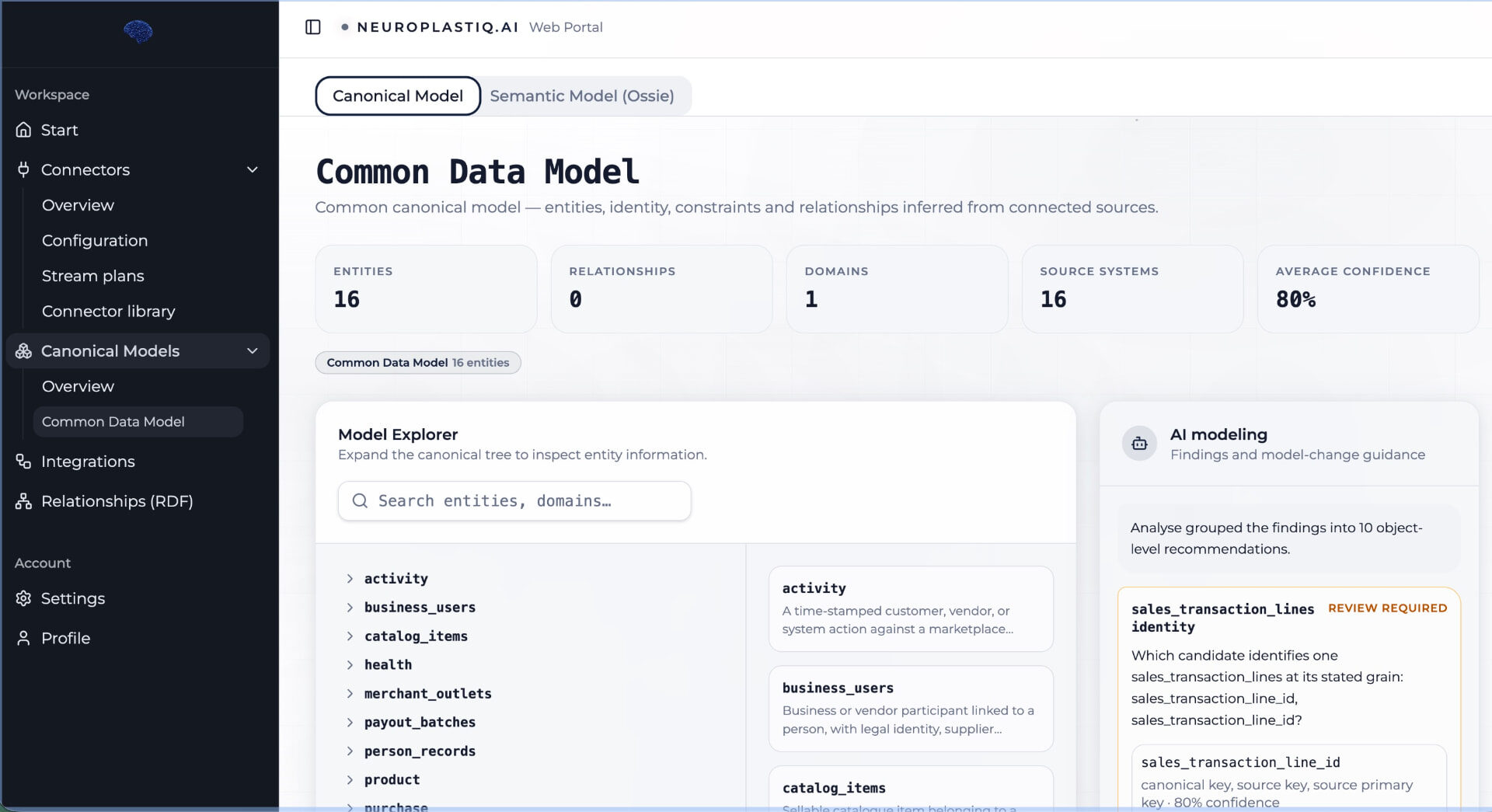
    Neuroplastiq's Common Data Model screen. It lists 16 entities inferred from 16 source systems at 80% average confidence, a Model Explorer with entities such as activity, business_users, catalog_items and person_records, and an AI modelling panel flagging a sales_transaction_lines identity question as review required.
    The common data model screen: entities inferred from connected sources, their definitions, and AI recommendations waiting for review.

    The problem

    The same data looks different in every system

    • Different systems represent the same customer, transaction or business concept differently.
    • Engineers dig through each source to learn how it behaves, then reconcile definitions and models that never quite match.
    • Documentation is often incomplete, or written for the people who run the application rather than the people who use the data.
    • Upstream changes need review and downstream updates.

    How it works

    A simple process to build and maintain your common data model

    Read the detail
    1. 1

      Connect your sources

      Analyse the structure of connected source systems, including their objects, attributes and relationships.

    2. 2

      Review the suggestions

      Inspect proposed definitions, relationships and modelling recommendations. Resolve questions that need business judgement.

    3. 3

      Build your common data model

      Refine and approve the shared entities, attributes, relationships and definitions.

    4. 4

      Use the model in your integrations

      Use the agreed model to inform integration and downstream data use. Describe particular delivery capabilities separately from model creation.

    5. 5

      Review changes over time

      Review proposed updates as source systems change, keeping people in control of changes to the model.

    You stay in control

    Neuroplastiq proposes. Your team decides.

    • Suggestions, not silent changes

      Neuroplastiq proposes. Your team implements or dismisses each recommendation, and the model only changes when approved.

    • Reasoning you can inspect

      Recommendations explain why they were made and what action is suggested, so reviewers can judge them on the evidence.

    • Decisions flagged for people

      Questions that need business judgement, such as which attribute identifies a record, are marked as needing review.

    How review and control work

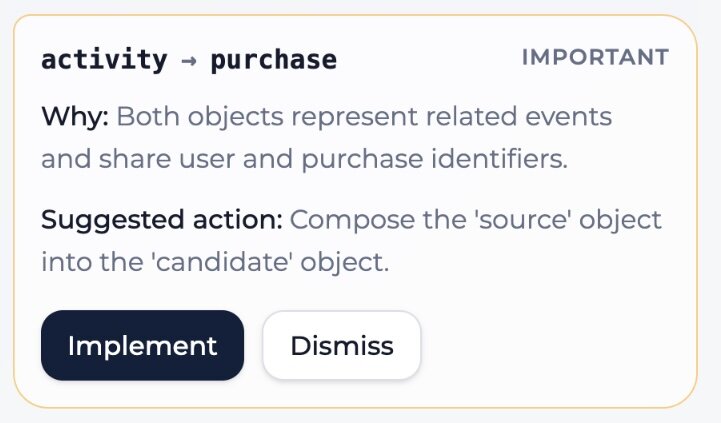
    A Neuroplastiq recommendation titled activity to purchase, marked important. Why: both objects represent related events and share user and purchase identifiers. Suggested action: compose the source object into the candidate object. Buttons: Implement and Dismiss.
    Every recommendation shows why it was made. A person implements or dismisses it.

    What is a common data model?

    A common data model gives your organisation a shared definition of data across its systems: names, attributes, characteristics, relationships and business meaning. It provides a foundation for system integration, data analytics and AI transformation. Without that shared understanding, teams spend more time reconciling differences and have less confidence in the results.

    Common and canonical data models are closely related. We use ‘common data model’ for shared structures and definitions across source systems, and ‘canonical’ when describing their standard representation for integration.

    How does Neuroplastiq help me build a common data model?

    Building a common data model involves understanding source structures, identifying relationships and reconciling different definitions. Teams then need to agree how those definitions should work across the business.

    Neuroplastiq accelerates discovery and modelling by analysing the systems you already run and proposing a shared model. Your team reviews the suggestions, resolves differences and agrees the definitions.

    This gives people concrete structures and recommendations to work through together, reducing manual discovery and repeated document exchanges. Business decisions remain with the people who understand the organisation.

    Read the Knowledge page

    See Neuroplastiq working on sample sources.

    We will walk you through the solution and understand your systems and goals to ensure we can deliver value for you.