We do it for you
Data Foundation Service
Neuroplastiq does the discovery and modelling work
Our team creates your common data model and semantic layer using Neuroplastiq, with your subject matter experts reviewing and validating the results.


Most valuable AI applications need data from multiple business systems. Neuroplastiq helps you create a common data model and semantic layer, giving your AI applications consistent data structures, relationships and business definitions to work with.
We do it for you
Neuroplastiq does the discovery and modelling work
Our team creates your common data model and semantic layer using Neuroplastiq, with your subject matter experts reviewing and validating the results.
Do it yourself
Your team does the discovery and modelling work
Your data engineers use Neuroplastiq to understand sources, review AI-assisted suggestions and build and maintain shared structures and business definitions.
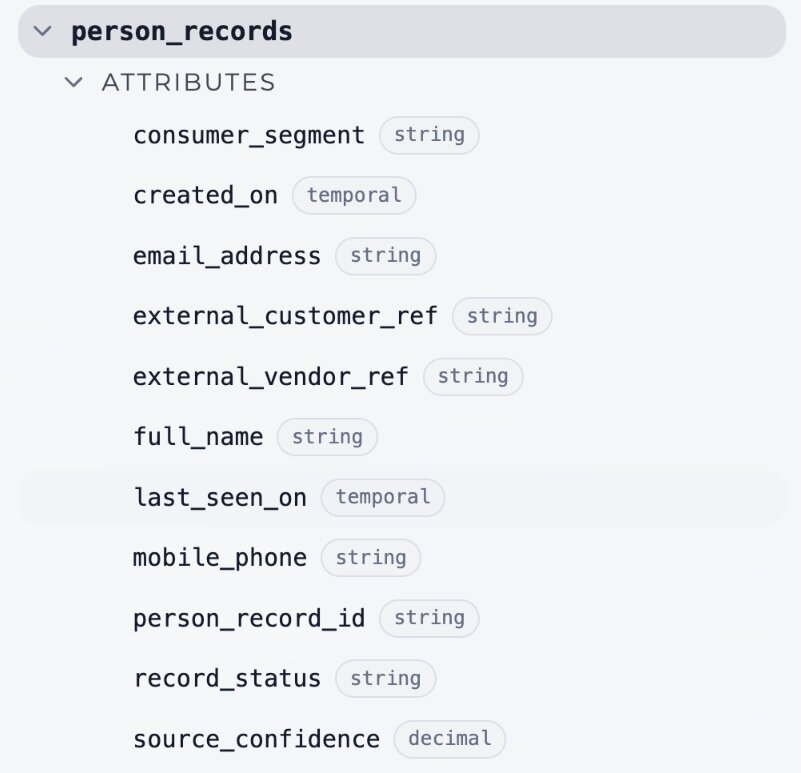
Your business systems often hold related data but use different structures, attributes, identifiers and business definitions. An AI application might need to combine customer, billing, product and support information to answer a single business question.
Connecting the AI application to those systems does not establish how the data relates. Without an agreed model, the logic for identifying customers, joining records and interpreting business metrics needs to be worked out for each use case. Different applications may reach different conclusions from the same underlying data.
A common data model and semantic layer establish those shared definitions and relationships, so teams can reuse them across AI, analytics and integrations.
You have four systems with information about customers, however the naming, format and data attributes are different in all four - so the AI doesn't have a clear way to answer the question.
CRM
Customer identity, account and ownership
Product
Usage and adoption history
Billing
Subscription, payments and renewal dates
Support
Requests, issues and resolution history
Common data model
Aligned customer identifiers, attributes and relationships
Semantic layer
Agreed definitions of active customer, product usage and renewal
AI application
Assess churn risk
Neither a common data model nor a semantic layer guarantees correct AI outputs or resolves all data quality problems.
How it works
Analyse the structure of connected source systems, including their objects, attributes and relationships.
Inspect proposed definitions, relationships and modelling recommendations. Resolve questions that need business judgement.
Refine and approve the shared entities, attributes, relationships and definitions.
Use the agreed model to inform integration and downstream data use. Describe particular delivery capabilities separately from model creation.
Review proposed updates as source systems change, keeping people in control of changes to the model.
You stay in control
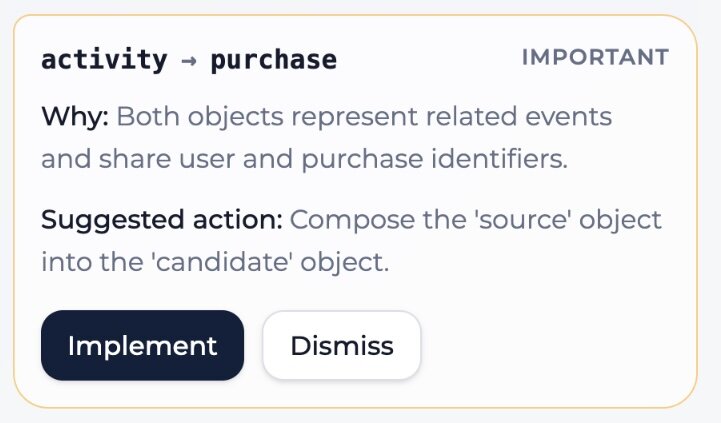
Neuroplastiq proposes. Your team implements or dismisses each recommendation, and the model only changes when approved.
Recommendations explain why they were made and what action is suggested, so reviewers can judge them on the evidence.
Questions that need business judgement, such as which attribute identifies a record, are marked as needing review.
A common data model gives your organisation a shared definition of data across its systems: names, attributes, characteristics, relationships and business meaning. It provides a foundation for system integration, data analytics and AI transformation. Without that shared understanding, teams spend more time reconciling differences and have less confidence in the results.
Common and canonical data models are closely related. We use ‘common data model’ for shared structures and definitions across source systems, and ‘canonical’ when describing their standard representation for integration.
Building a common data model involves understanding source structures, identifying relationships and reconciling different definitions. Teams then need to agree how those definitions should work across the business.
Neuroplastiq accelerates discovery and modelling by analysing the systems you already run and proposing a shared model. Your team reviews the suggestions, resolves differences and agrees the definitions.
This gives people concrete structures and recommendations to work through together, reducing manual discovery and repeated document exchanges. Business decisions remain with the people who understand the organisation.
In a free discovery workshop, we will discuss your outcomes and systems, and explore whether our delivered service or the do-it-yourself Neuroplastiq platform is the right fit.